The System That Preserves Leadership Clarity
Leadership rarely unfolds in calm environments. Executives allocate capital while markets shift beneath them. Operators manage systems where small failures can cascade into operational crises. Fathers guiding families often regulate their responses in emotionally charged moments where tone, timing, and judgment shape the stability of the household.
Some leaders maintain clarity even as volatility rises. Others experience fragmented thinking, emotional reactivity, or decision fatigue that gradually degrades judgment. The difference is rarely intelligence. More often, it is the presence or absence of cognitive sovereignty.
Cognitive sovereignty describes the ability to govern the internal systems that interpret emotional signals, allocate attention, and coordinate reasoning before behavior occurs.
The Decision Architecture of Cognitive Sovereignty
Every leadership decision passes through a governing structure before behavior occurs, understood through a simple model:
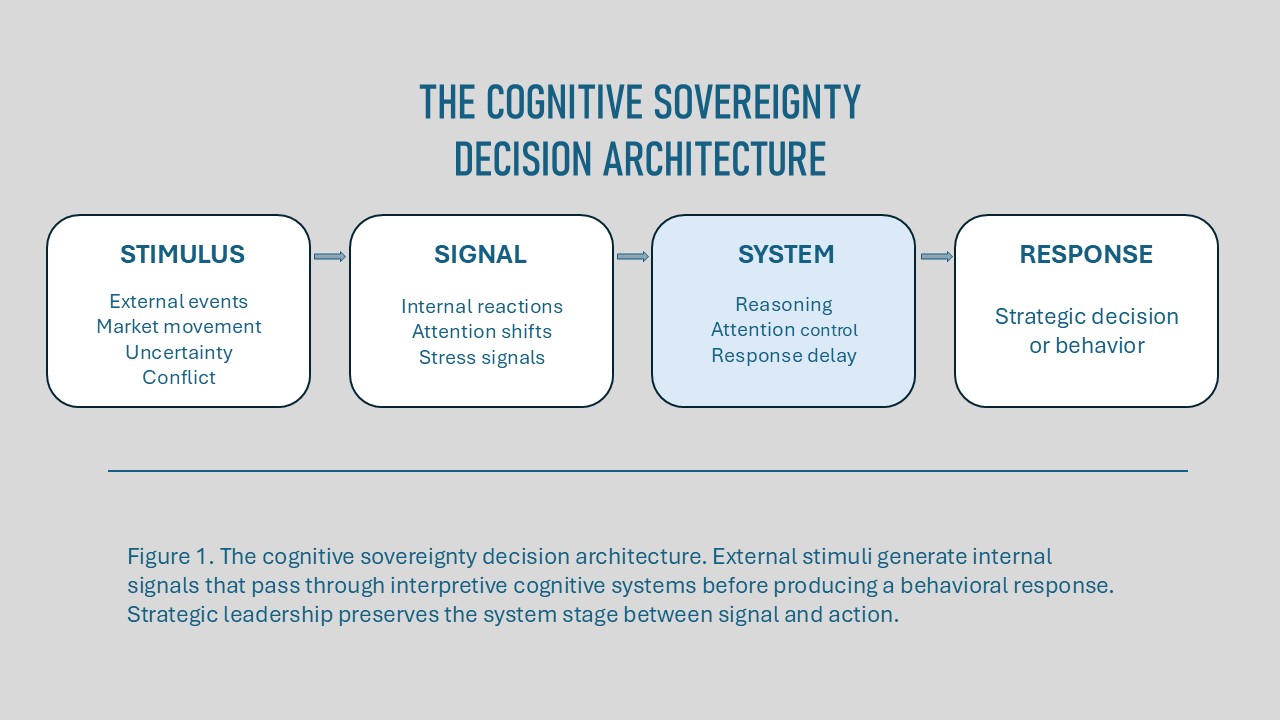
Stimulus — external events occurring in the environment. Signal — internal reactions generated in response to those events. System — the interpretive stage where signals are evaluated before behavior occurs. Response — the final action or decision produced after signals pass through the governing system.
Untrained systems tend to follow a shorter pathway:
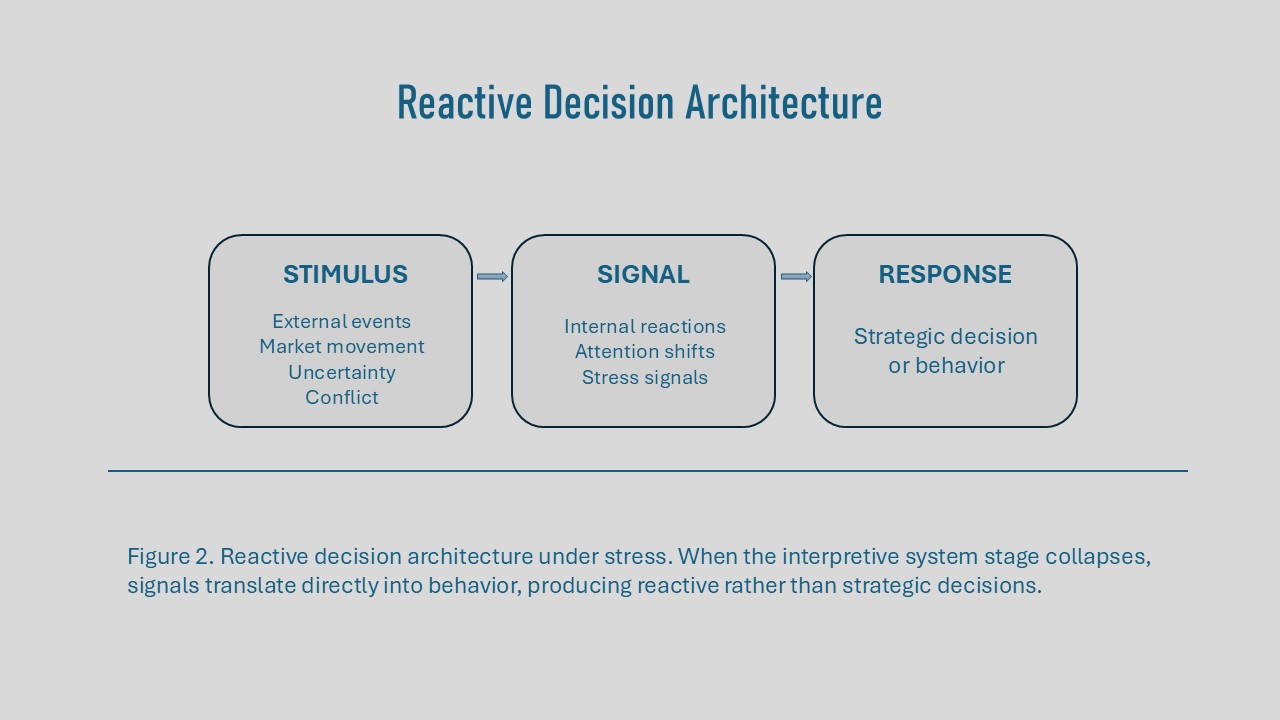
When signals translate directly into behavior, decision making becomes reactive. Leaders operating with cognitive sovereignty preserve a brief interruption between signal and action.
Emotional Signal Interpretation and Cognitive Sovereignty
A persistent misconception in leadership culture suggests that effective decision makers suppress emotion entirely. Emotional responses function as signal detection mechanisms. They highlight potential threats, emerging problems, and subtle shifts in social dynamics that may not yet be visible through analytical reasoning alone.
The breakdown occurs when emotional signals become behavioral commands rather than informational inputs.
Stress and the Collapse of Cognitive Sovereignty
Stress does not immediately eliminate reasoning capacity. Instead, it compresses the time available for deliberate evaluation. Under pressure neural processing begins shifting toward faster emotional circuits that favor rapid reaction.
Cognitive sovereignty protects against this collapse by preserving the interpretive stage between signal and response.
Neural Systems Supporting Cognitive Sovereignty
Strategic reasoning depends on coordination between several large scale neural systems. The Central Executive Network supports analytical reasoning and complex problem solving. The Salience Network functions as a prioritization mechanism, identifying which signals in the environment deserve attention. The Default Mode Network supports internal reflection and mental simulation, allowing decision makers to integrate past experience and anticipate potential future outcomes.
When these systems coordinate effectively, reasoning remains stable even under pressure.
Decision Environments as Cognitive Infrastructure
One of the consistent observations among experienced leaders is that they rarely rely on mental effort alone to manage complexity. Instead, they structure the environment in which decisions occur — organizing critical information so important variables remain visible, using decision frameworks rather than reasoning informally, and pacing conversations so the most relevant signals remain in focus.
In practice, leadership environments function as cognitive infrastructure. They either support coherent reasoning or destabilize it.
The Trainable Nature of Leadership Cognition
Neural networks responsible for attention control, reasoning, and emotional regulation become more efficient when they are repeatedly engaged in structured cognitive activity. Experienced decision makers preserve response pacing, structure complex decisions using external frameworks, and externalize critical information visually rather than attempting to maintain multiple variables in working memory.
What appears externally as composure is often the visible result of trained response architecture.
Leadership Composure as System Architecture
Individuals who maintain clarity during volatility are rarely calmer by nature. More often they have developed systems that stabilize attention, interpret emotional signals, and preserve reasoning capacity under pressure. This coordinated condition is what neuroscience describes as cognitive coherence.
The Difference Between Strategy and Reaction
The defining difference between reactive leadership and strategic leadership is not the absence of emotion. It is the presence of a governing system capable of interpreting emotional signals before action occurs.
When that architecture remains intact, emotional information becomes insight rather than impulse. In volatile environments this distinction determines whether leadership produces strategy or reaction.
References
Arnsten, A. F. T. (2009). Stress signalling pathways that impair prefrontal cortex structure and function. Nature Reviews Neuroscience.
Raichle, M. E. et al. (2001). A default mode of brain function. Proceedings of the National Academy of Sciences.
Seeley, W. W. et al. (2007). Dissociable intrinsic connectivity networks for salience processing and executive control. Journal of Neuroscience.